
Connecting agent workflows, knowledge and execution across the computing continuum
An AI workflow can involve several agents, multiple models, enterprise knowledge and computing resources spread across a factory, a data centre and the cloud. Making those pieces work together requires more than connecting APIs. The system must coordinate the work, respect access and location constraints, understand execution conditions and leave enough evidence for people to investigate the result.
SparkWeave is BitSparkles’ initiative to develop a cognitive orchestration and AgentOps layer for this challenge. Its architecture connects the purpose of an AI workflow with the resources and knowledge available to carry it out. Cognitive Observability links the resulting activity to operational evidence, so teams can assess both the workflow and its execution context.
Development status: SparkWeave is in development. This article describes its public architecture and intended responsibilities. Supported integrations, production availability and performance results will be communicated as they are validated.
In this article: The architecture at a glance Connecting behaviour with execution evidence Evidence informs controlled adaptation An industrial workflow in practice Interoperability with clear responsibilities
Why distributed AI needs a shared architecture
Consider an industrial assistant that investigates a machine anomaly. One agent may interpret an event, another may retrieve maintenance guidance, and a third may prepare a recommendation for an engineer. Some information may need to remain on site. A suitable model may be available at the edge, while another stage could use cloud or high performance computing resources.
The engineering problem crosses several boundaries. Agent coordination alone does not establish where execution is permitted. Infrastructure health alone does not show whether an answer used the right evidence. A model response alone does not explain which tools, sources and runtime conditions contributed to it.
SparkWeave’s architectural approach brings these concerns into a coordinated system. The computing continuum means the available range of device, edge, cloud and, where relevant, high performance computing environments. The objective is to make that distribution manageable without assuming that every environment offers the same capabilities.
The architecture at a glance
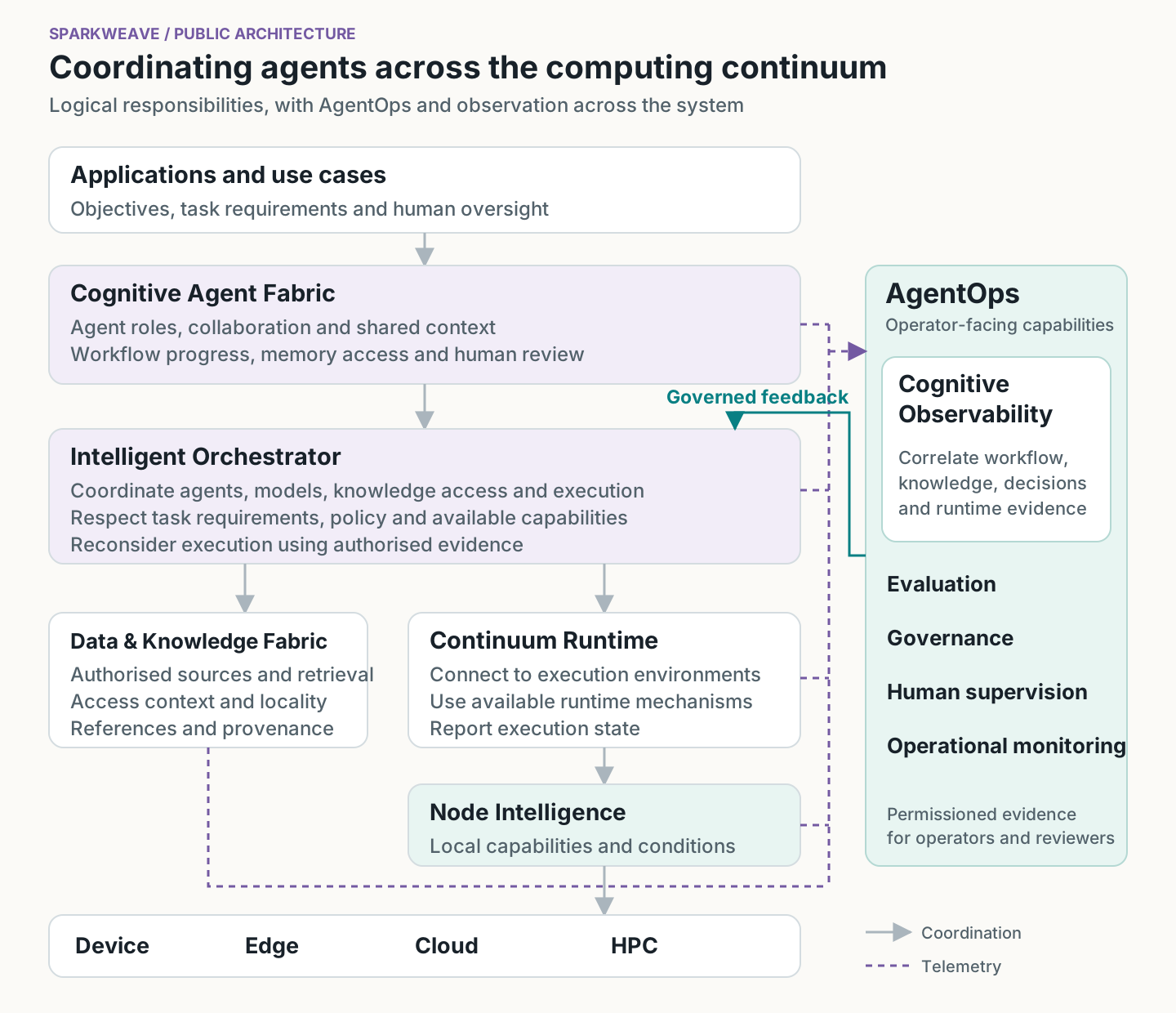
The public model separates workflow coordination, orchestration, knowledge access and execution. Node Intelligence supplies the local view of execution capabilities. AgentOps spans these components, with Cognitive Observability correlating their recorded activity.
Cognitive Agent Fabric
The Cognitive Agent Fabric is where application work is organised into agent workflows. Its responsibilities include roles, task decomposition, shared context, memory access, collaboration and human review. It describes how specialised agents contribute to a common objective and how work moves between them.
This gives application teams a place to express the workflow without embedding every infrastructure decision into individual agents. A retrieval agent can request authorised knowledge; an analysis agent can use an appropriate model; a reviewer can approve an action. The fabric coordinates these contributions and exposes explicit workflow events for observation.
Intelligent Orchestrator
The Intelligent Orchestrator connects workflow requirements with available agents, models, data access and execution environments. Its public responsibility is to coordinate suitable execution under the constraints of the task and the deployment: for example, locality, access permissions, resource availability and service objectives.
It also provides the architectural point at which execution can be reconsidered when conditions change. An operator should be able to inspect the recorded outcome and an authorised, high level explanation of the applicable constraints. That explanation can describe a permitted execution location without exposing the internal method used to compare alternatives. Decision algorithms remain encapsulated within BitSparkles technology.
Data and Knowledge Fabric
The Data & Knowledge Fabric connects workflows to authorised information: operational data, documents, retrieval services, knowledge graphs and other enterprise sources. It brings access context, source references and provenance into the workflow, while accounting for where information is held and where it may be used.
Knowledge access has two distinct consequences. An agent needs relevant material to complete its task, and an investigator needs an appropriate record of the evidence that was used. A source reference and version can help support that investigation without copying the full source into every trace. Access to retrieved material remains subject to the source’s permissions and the deployment’s policies.
Continuum Runtime
The Continuum Runtime connects orchestration intent to the execution environments that can carry it out. These environments may include devices, edge systems, cloud infrastructure or high performance computing facilities. The runtime’s role is to work through the execution mechanisms available in each environment and report the resulting state.
This is an integration boundary. Existing platforms retain their own workload lifecycle and execution responsibilities. For example, Kubernetes already separates scheduling from node execution, with the kubelet ensuring that assigned Pods run on a node. SparkWeave’s architectural focus sits above those mechanisms, connecting them to AI workflow requirements. Kubernetes components
Node Intelligence
Node Intelligence supplies the local view needed to make distributed execution meaningful. Its architectural remit includes reporting available compute, model and runtime availability, relevant data locality and current operating conditions. At eligible execution sites, a node agent or infrastructure adapter connects that view to the wider system.
The important question is whether a site can support a particular AI task under its operating constraints. CPU and memory are part of the answer, alongside the availability of the required model, tools and permitted data access. Local execution remains subject to authorised policy and runtime capabilities. Managed services may expose their capabilities through service integrations rather than a host level agent.
AgentOps
AgentOps is the operator-facing capability for running and evaluating the distributed agent system. In this architecture, it brings together operational monitoring, workflow inspection, evaluation, governance and human supervision. It helps teams move from an individual event to the wider execution that gives the event meaning.
For an application owner, the question may be whether a task completed with appropriate evidence and review. For an operations team, it may be where a failure occurred or which dependency became unavailable. AgentOps brings these views together while respecting access boundaries. Cognitive Observability is a core technical capability within this broader operational scope.
Cognitive Observability
Cognitive Observability is the transversal capability that correlates recorded agent activity with knowledge access, orchestration outcomes and runtime conditions. It follows the workflow across component boundaries, rather than treating each model call or infrastructure metric as an isolated event.
Here, cognitive refers to explicit system behaviour: task progress, agent handoffs, tool use, context access, exposed plan states, verification results and human interventions. A component may expose a structured explanation or planning event; that record is still an observation of what the component reported. It does not establish access to a model’s hidden reasoning or prove that an explanation faithfully describes its internal processes.
Connecting behaviour with execution evidence
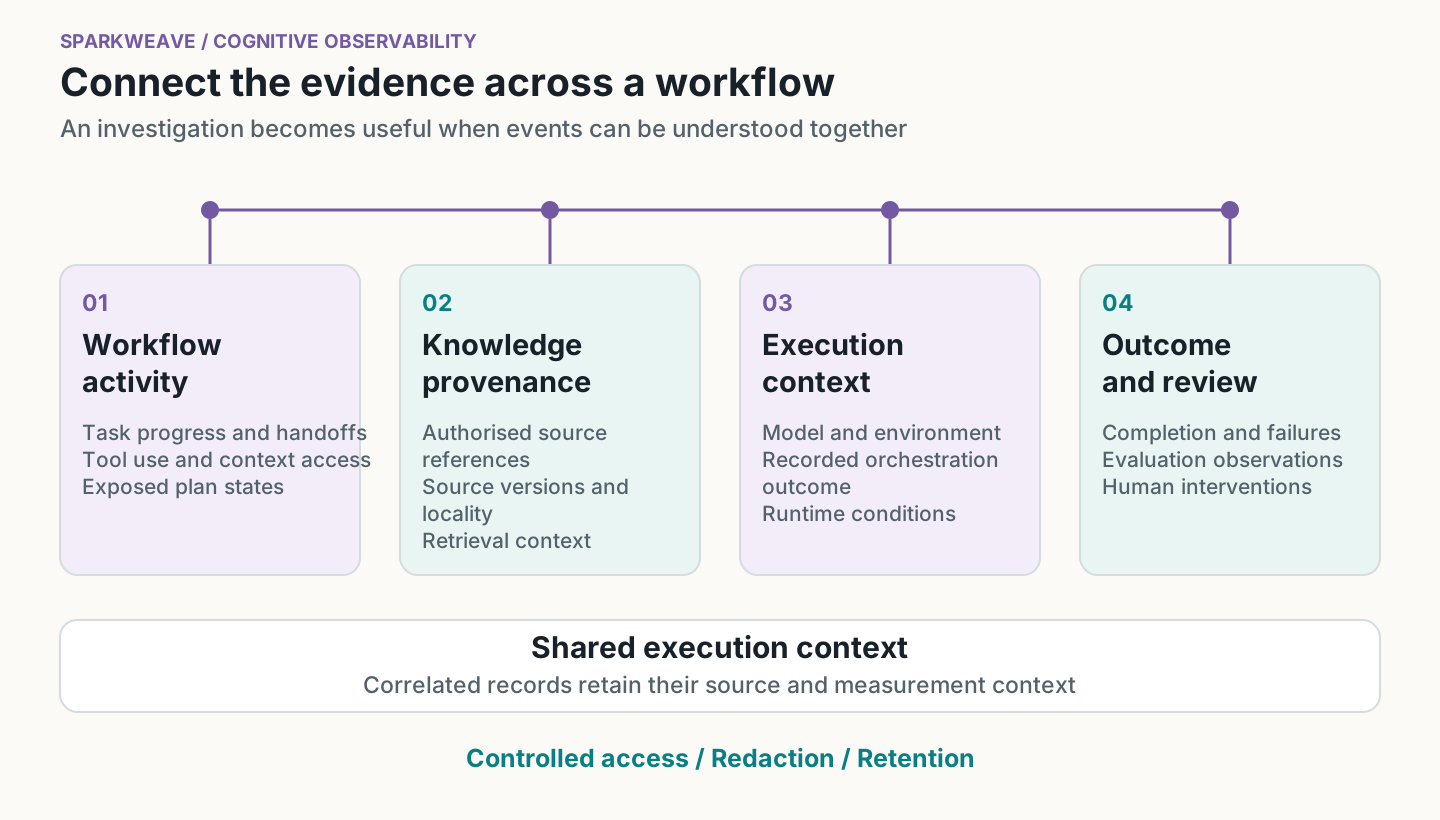
Useful observability answers questions across the system. Which agent handled the task? Which authorised sources were consulted? Which model and execution environment were used? Did a tool fail? Was the output evaluated, and did a person intervene?
In the SparkWeave architecture, these questions meet in a correlated execution record. The value is the relationship between events: a tool error can be examined alongside the affected workflow step; a delayed result can be investigated alongside resource conditions; a recommendation can be linked to the available source references and review outcome.
Evidence needs context of its own. Missing instrumentation or a disconnected execution site can leave gaps. A recorded evaluation result describes a particular evaluation, not a universal measure of correctness. Confidence reported by a model needs validation before it can be treated as a reliable probability. Cost or energy observations also need a clear measurement basis; estimates should be identified as estimates.
Observation must respect information boundaries. Prompts, retrieved content, tool results and detailed logs may contain confidential material. The public design principle is to collect what is necessary, control who can inspect it, and apply suitable redaction and retention. Operational visibility does not require publishing raw prompts, private reasoning traces or internal decision records.
Evidence informs controlled adaptation
Observation becomes operationally useful when it supports a permitted response. If a dependency becomes unavailable or an execution site degrades, the system needs a way to reconsider the affected work. Cognitive Observability supplies evidence; the Intelligent Orchestrator remains the architectural decision point for any orchestration change.
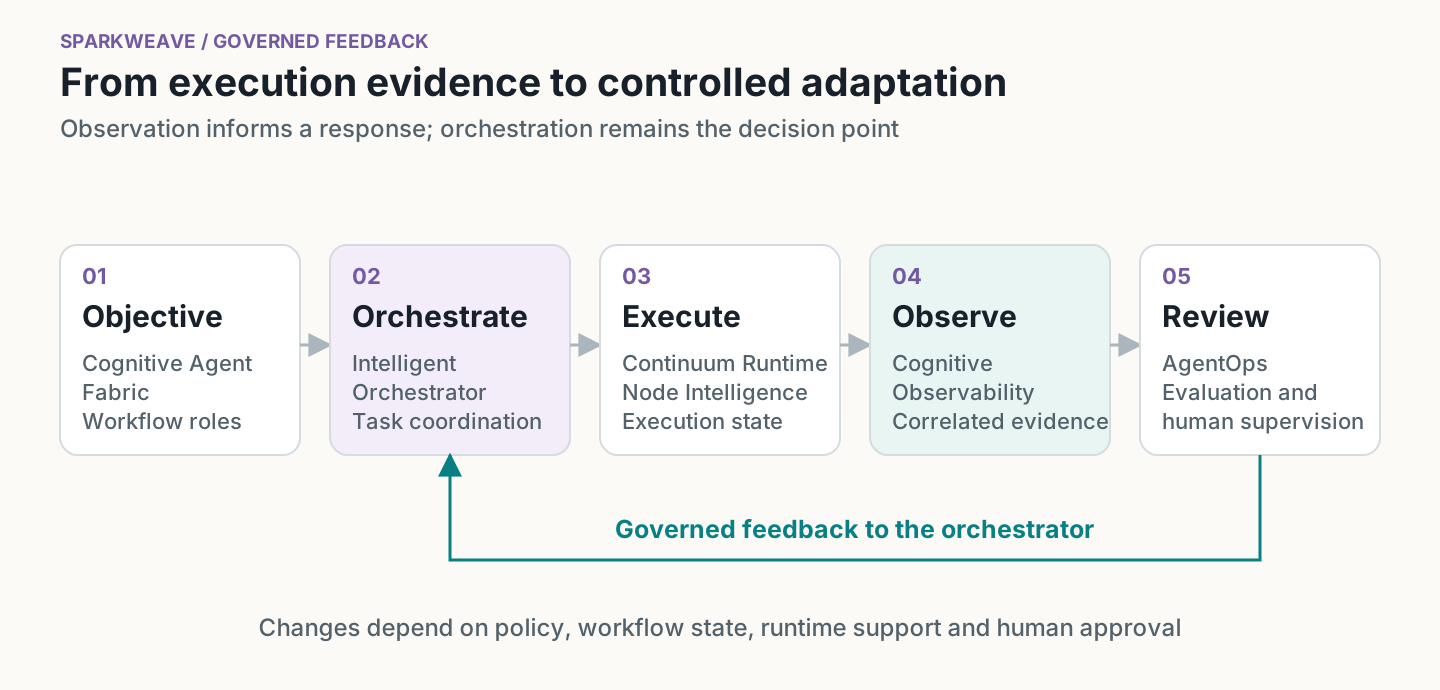
The feedback relationship is operational. It can inform the handling of subsequent tasks or a supported change to execution. Retraining a model, changing an agent’s objectives or rewriting policy would require separate controls. Likewise, moving ongoing work depends on whether its state and runtime support that operation.
This separation keeps responsibility clear. The observation capability reports evidence. AgentOps makes that evidence useful for evaluation and supervision. The orchestrator considers authorised responses, and the runtime carries out supported execution changes.
An industrial workflow in practice
Consider an illustrative maintenance workflow. A site event starts an investigation, and the Cognitive Agent Fabric coordinates an analysis agent, a knowledge retrieval agent and a human review step. The workflow’s purpose is to prepare an evidence-backed recommendation for an engineer.
The Data & Knowledge Fabric provides access to authorised maintenance guidance and relevant operational context. The Intelligent Orchestrator coordinates execution within the deployment’s constraints. If the use case requires raw operational data to remain on site, that restriction forms part of the execution requirements. Node Intelligence reports the local capabilities available, and the Continuum Runtime connects the work to a supported execution environment.
Cognitive Observability links the recorded workflow steps to the sources consulted, the execution context and the review outcome. The engineer can investigate the recommendation using the evidence they are authorised to see. If an execution dependency becomes unavailable, the system can surface the interruption and support a permitted response, including human review when required.
This example describes the responsibilities working together. It does not imply a deployed customer case, a measured performance result or automatic authority to change an industrial process.
Interoperability with clear responsibilities
The architecture is intended to accommodate established interfaces where they fit. These interfaces address different boundaries. The Model Context Protocol provides a model for connecting AI applications to tools and resources. Agent2Agent addresses collaboration between agents across system or framework boundaries. Neither protocol, by itself, determines the placement of work across infrastructure. MCP architecture, A2A overview
For observability, OpenTelemetry provides established concepts for tracing distributed work. Trace context allows operations emitted by different components to be correlated. That is a useful foundation for an architecture that must relate agents, tools, retrieval and execution environments. The meaning and coverage of the resulting evidence still depend on instrumentation and application context. OpenTelemetry traces
These technologies are interoperability references, not a statement that every corresponding SparkWeave integration is available. Support depends on the integrations validated for a particular deployment.
What this architecture makes possible
The value of the SparkWeave approach lies in connecting decisions that otherwise sit apart: what the workflow is trying to achieve, what knowledge it may use, where execution is permitted and what the recorded outcome shows. A node agent or a tracing dashboard alone cannot provide that whole relationship.
For teams building distributed AI, this creates a practical architectural direction: make agent workflows aware of execution constraints, make operations aware of workflow context, and give people evidence they can use to evaluate the result. BitSparkles’ development focus is to bring those responsibilities together while keeping the orchestration technology encapsulated.
Explore your distributed AI workflow
Start with a concrete workflow, its data boundaries, the environments available to execute it and the evidence your team needs to evaluate success. These requirements provide a useful basis for an architecture discussion or collaborative proof of concept.
Discuss your use case with BitSparkles or explore the SparkWeave solution page.